
 Disney crowd forecast
When does Tokyo Disney's off-season end? January vs February

Split the two winter months usually sold as one off-season and they come apart. January really does sit near the bottom of the year. February sits on the busy side. We suspected Lunar New Year traffic; the measurement did not back it.
"January to February is the off-season" is half right. Compared on weekdays with holidays and school breaks removed, January reads Fairly easy and February reads Fairly busy — two levels apart on the scale. The genuinely quiet months are July, August, September; the busy ones are March, November, February.
January and February are two steps apart
Across 24 months and 446 weekdays: January reads Fairly easy, February reads Fairly busy — two levels apart.
The quietest month is July at Easy; the busiest is November at Fairly busy. February sits on the busy side, not the quiet one.
Lumping "January to February" together is the mistake
Off-season advice almost always reads "mid-January through February". For January the measurement agrees. It comes out at Fairly easy, near the bottom of the year.
February does not. Same winter, same weekdays, different level. The moment you merge them, one half is wrong.
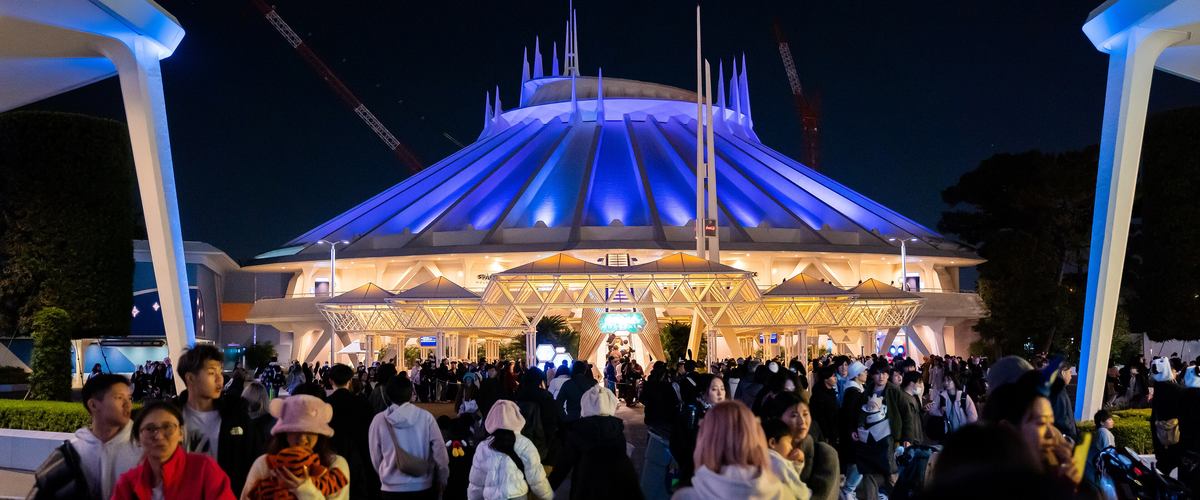
We suspected Lunar New Year. The data said no
Two candidates for February: Japanese graduation trips, and Lunar New Year traffic from China and Taiwan. On 1 September 2026, while recalibrating the model, we cut the Lunar New Year weeks out of two years of measured data (queue-times.com, both parks) and compared them once. That working is not published on this site.
It did not hold. The 2025 Lunar New Year week came out below its own month's average, and the Korean Chuseok week lower still. The 2026 week is high, but February is a high month anyway, so the two cannot be separated. Honestly: we have not identified the cause.
So where is it actually quiet?
The lowest level belongs to July, August, September. Not "winter is quiet" but "these months are quiet" fits the measurement better.
The month alone is not enough, though — the weekday moves it two steps inside the same month. Weekdays are here, the full month picture here, holiday runs and school breaks here.
January moves three levels inside itself
Having written that January and February should not be lumped together, we lumped January together. Split the 15 weekdays in January and 9 of them read Fairly easy; the rest sit above.
So "any day in January" is not the advice. The weekday still moves the level inside the month. To find the lowest days, read this alongside the weekday article.
If February is the only month you have
February runs high, but not every day of it. Of the 18 weekdays in February, 10 read Normal. That is more than half.
What to avoid is not the month but its upper half. The high days are Mondays and Fridays, not the days flanking a public holiday. Some of February's quietest weekdays sit right after one.
Quiet season
The season the model uses to pull the crowd down covers 206 days, 28% of the year. It averages Easy against Normal for the year, 2 levels apart. Of those 206 days, 205 — 100% — come in below the yearly average. Split by month, though, the winter months are not the ones that show up.
28% of the year is "quiet season"
The factor fires on 206 days, 28% of the 724 we score. The season averages Easy against Normal for the year. These 206 days are held below the yearly average as one block.
205 of them (100%) land below the yearly average. Of the 32 busiest days in the year, not one falls inside this season.
A quiet season does not mean a cheap room
Inside this season, 143 nights pull room rates down and 63 push them up. The park sits below the yearly average, yet 31% of the nights are still on the climbing side.
Picking a quiet season for the park does not make the room cheap by itself. Park crowds and room rates explains the mechanism; the mirror is counted in the busy season.
Gaps between events
We hold 3 verified events, with 2 gaps between them. Together those come to 16 days. The longest gap runs 10 days, but from Nov 1 (Sun) the next event is already on sale. Cut at that date and the gaps shrink to 6 days.
3 events, 2 gaps between them
We verified 3 events to a source. Put them in date order and the blank stretches between them number 2.
They are Nov 1 (Sun)〜Nov 10 (Tue), 10 days and Dec 26 (Sat)〜Dec 31 (Thu), 6 days. Together that is 16 days.
Between Sep 16 (Wed) and Jan 11 (Mon), that is every date outside an event. Earlier dates simply have no verified event on them yet.
We only hold what we could verify
What is listed here is only what we could trace to a source. Anything unverified never entered the table, so these gaps are blanks between 3 events and nothing more.
So we will not write "nothing is on". What we will write is that within what we checked, the space between them adds to 16 days.
Periods verified against オリエンタルランド プレスリリース(PR TIMES) as of Sep 2, 2026; launch dates against オリエンタルランド プレスリリース(PR TIMES), checked Sep 11, 2026.
Last updated: 2026-09-11